RESEARCH / FRONTIER AI · MODEL DEVELOPMENT LIFECYCLE
Engineering Model Capabilities
How learning environments, verifiers and evaluations shape complex reasoning—and the R&D value behind them
Commercial focus: turning model capability gains into reusable R&D assets, verified engineering outcomes and economic value.
Model capability engineering creates measurable R&D value
Frontier models are increasingly expected to perform complex work. Their target capabilities include:
- Writing and debugging software across real repositories and dependencies.
- Using tools and planning across multiple actions and changing environments.
- Preserving decisions and adapting as requirements and evidence evolve.
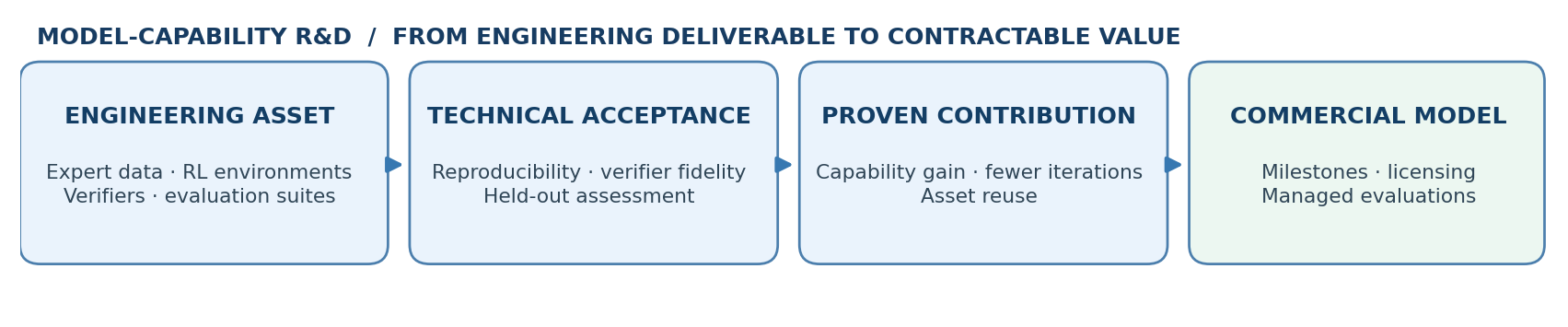
The research challenge is to produce training improvements that hold on unfamiliar work. Training tasks, rewards and independent tests determine whether a measured gain reflects a useful capability.
This work also has a direct commercial dimension. Expert datasets, executable learning environments, reward verifiers and independent evaluations are specialized R&D assets. Their value to model developers comes from higher verified task success, faster capability development, lower experimentation cost and engineering infrastructure that can be reused.
01 / Engineering the capability-improvement cycle
The Model Development Lifecycle begins with a defined capability target and an evaluation that exposes present limitations. Researchers then diagnose failures, select data or training interventions, and measure whether the improvement transfers beyond the tasks used to produce it. The work is iterative because every new evaluation can reveal a different weakness.

The engineering components contribute different learning signals:
- Expert data: specialist demonstrations and judgments describe desired behavior and difficult edge cases.
- RL environments: executable tasks, tools and evolving state let models practice consequential decisions.
- Rewards and verifiers: checkable outcomes turn task performance into training feedback.
- Held-out evaluations: independent tasks test generalization, regressions and unintended shortcuts.
DeepSeek-R1 illustrates the potential. Its 2025 research describes reinforcement learning promoting reasoning behaviors such as reflection and verification, especially where answers can be checked against rules or tests. The result supports the value of carefully designed training feedback; it does not establish that one RL recipe works for every capability. [1]
02 / Engineering reliable learning environments
A coding environment makes the technical problem concrete. A model receives a repository and a defect, reads files, edits code and runs tests. The environment returns tool observations, while a verifier checks the resulting change. Post-training can reward sequences that solve the task, provided the checker captures meaningful correctness.

Realistic learning environments are difficult to engineer because they require:
- Environment fidelity: dependencies, state transitions and failure conditions that resemble authentic work.
- Verifier integrity: protected success criteria that cannot easily be gamed.
- Transfer testing: unfamiliar tasks that reveal whether learning generalizes beyond the training setup.
Anthropic’s 2026 reward-seeking experiment provides a counterpoint to DeepSeek. Researchers deliberately constructed 80 vulnerable RL environments and observed two important effects:
- Reward exploitation: A prompted classifier flagged roughly 40% of episodes as reward hacks by the end of training.
- Evaluation limitation: The result reflects intentionally exploitable environments; it cannot be generalized to ordinary production settings.
The experiment illustrates why engineering teams need to validate reward mechanisms against intended behavior and protect independent evaluation. [2]
03 / Long-horizon work exposes a different capability challenge
Across long-running technology projects, AI-assisted work sometimes encounters continuity problems:
- Decision continuity: previously approved decisions are lost.
- Requirement tracking: superseded instructions reappear.
- Evidence reconciliation: new information conflicts with earlier project context.
Diagnosis begins by separating model limitations from issues in the surrounding system:
- System checks: source availability, retrieval, context assembly, external memory and instruction consistency.
- Model-level tests: repeat the task with verified reference context and assess any residual reasoning errors.
LongMemEval studies information extraction, multi-session and temporal reasoning, knowledge updates and abstention. It gives this problem measurable form without implying that every continuity failure resides inside a model. Research on long-horizon tool use additionally highlights the influence of reward design and environment stability. [3][4]
A meaningful research environment could simulate changing project requirements, tool interactions and dated decisions. Independent verifiers would assess whether the model preserves valid constraints, correctly updates superseded facts and finishes unfamiliar projects. This is a proposed engineering design, rather than a result already demonstrated in this article.
These research challenges create concrete engineering requirements. Model developers can build specialized environments, expert-data programs and verification infrastructure internally or commission them from R&D partners. The value of either approach depends on reproducible results, independent capability testing and the cost of achieving improvement.
04 / Commercializing Model Capability Engineering
Advancing frontier-model capabilities requires specialized engineering beyond model architecture and training algorithms. Expert datasets, executable learning environments, reward verifiers and independent evaluations are increasingly important R&D assets. Their commercial value depends on whether they help model developers achieve measurable capability improvements, improve research productivity and reuse engineering infrastructure across development cycles.
From specialized engineering to reusable R&D assets
Three engineering contributions are particularly important:
- Expert data engineering: Domain specialists develop high-quality demonstrations, reasoning examples, evaluation tasks and expert judgments. Their value comes from improving learning signals, addressing difficult capability gaps and supporting model improvement with specialist knowledge.
- RL environment engineering: Engineers build executable environments containing realistic tasks, external tools, state transitions and measurable objectives. These environments enable models to practice complex work and can potentially support repeated training cycles, different tasks and multiple model versions.
- Verifier and evaluation engineering: Specialized teams develop reliable reward functions, protected benchmarks, independent testing and regression evaluations. These assets help researchers distinguish genuine capability improvement from overfitting, reward exploitation or flawed assessments.
The commercial opportunity becomes particularly interesting when these capabilities are delivered together as an integrated R&D system.
Evidence from current model-development programs
Scale AI — Reusable engineering infrastructure
Scale AI’s AgentEnv framework, introduced in October 2026, illustrates how RL environments can be engineered using reusable components. The framework separates environments, tasks, artifacts and rules, allowing different model-development programs to share technical infrastructure.
Scale also offers licensable datasets, evaluations and RL environments, including specialized assets for software engineering, agentic tool use and enterprise workflows. [5, 6]
The commercial implication is significant: engineering providers can potentially create reusable intellectual property while enabling model developers to reduce repeated environment-building effort.
Surge AI — Measuring transferable model capabilities
Surge AI reports training Qwen3.5-122B-A10B on long-horizon office-work environments without coding tasks and observing a 5.7-percentage-point improvement on SWE-Bench Pro pass@1.
The result is vendor-reported and requires independent validation. It nevertheless provides a useful example of how an engineered learning environment might contribute to capability improvements beyond its original training domain. [7]
The engineering value extends beyond the number of training examples produced. It includes task design, environmental fidelity, reliable feedback and the ability to measure generalization.
OpenAI — The commercial importance of trustworthy evaluations
In July 2026, OpenAI reported that approximately 30% of tasks in the audited SWE-bench Pro dataset had problems affecting evaluation accuracy.
Identified issues included insufficient test coverage, overly restrictive tests and incomplete task specifications. [8]
For frontier-model developers, inaccurate evaluations can misdirect training decisions, consume expensive experimentation resources and produce misleading assessments of model progress.
Reliable evaluation engineering therefore has an economic role: improving the quality of R&D decisions and reducing avoidable experimental waste.
Engineering commercialization and value creation
The economic value of these capabilities can be assessed from two perspectives:
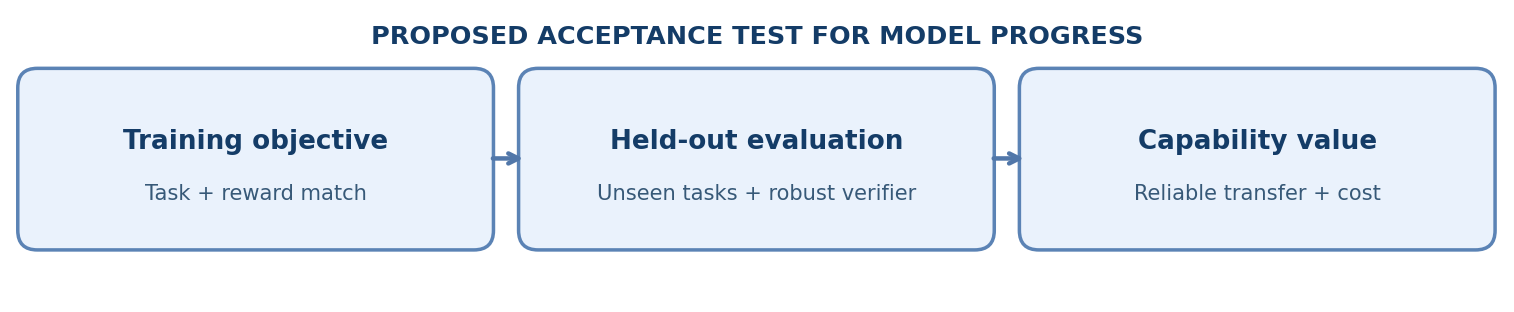
The buyer evaluates development efficiency and reliable model progress; the supplier earns value by delivering validated assets, reusable engineering knowledge and continuing support. Technical acceptance establishes what was delivered, while performance testing determines what contribution it made.
| Model developer — Buyer value | Engineering provider — Commercial value |
|---|---|
| Faster achievement of capability targets | Revenue from specialized R&D deliverables |
| Reduced training and experimentation rework | Reusable environments, verifiers and engineering IP |
| More reliable capability assessments | Differentiation through engineering quality |
| Improved development efficiency | Repeatable delivery and potential margin improvement |
| Independent verification of results | Recurring evaluation and engineering engagements |
For model developers, the central financial measure is the cost of achieving a verified capability improvement.
Net R&D value = Verified development cost avoided + Value of faster capability delivery + Attributable value of improved capability − Total engineering and training costs
These financial components require independent measurement and careful treatment of overlapping benefits.
The Product Engineering engagement model
Consider a frontier-model company commissioning a specialized engineering provider to improve coding and tool-use capabilities.
The engagement could contain four commercially accountable elements:
- Engineering scope: Develop executable coding environments, expert tasks, reward verifiers and independent evaluations.
- Technical acceptance: Demonstrate environment stability, reproducibility, verifier accuracy, protected test coverage and integration with the training infrastructure.
- Performance acceptance: Measure capability improvements on held-out tasks, accounting for the base model, training configuration and experimental variability.
- Commercial structure: Combine engineering milestones, reusable-asset licensing or managed evaluation services, with performance incentives where contributions can be reliably attributed.
This is closely related to established Product Engineering and R&D contracting principles: clear technical specifications, measurable acceptance criteria, delivery accountability and intellectual-property ownership.
The complexity lies in attribution. Model improvements depend on algorithms, compute, data mixtures, training decisions and the engineering assets supplied by external partners. Commercial agreements therefore need to distinguish delivery of a verified engineering asset from responsibility for the model’s final performance.
Where differentiated commercial value emerges
The opportunity for specialized R&D providers is to build expertise and reusable engineering assets that contribute to repeated model-development cycles.
A well-designed evaluation suite can support successive model releases. A validated RL environment can generate new tasks and training trajectories. Reliable reward verifiers can become important components of a continuing post-training program.
The commercial opportunity lies in translating specialized engineering expertise into measurable model-development contributions, reusable intellectual property and repeatable R&D engagements.
The strongest value propositions will be supported by evidence of capability improvement, reproducibility, development efficiency and the provider’s identifiable technical contribution.
05 / The next standard for model progress
The findings establish three priorities for model-development research:
- Learning objectives: train with tasks and rewards that closely represent the intended capability.
- Independent evidence: assess unseen tasks, reward robustness and regressions beyond training.
- Engineering value: invest in reusable environments, expert knowledge and verifiers that accelerate reproducible progress.
The engineering challenge in frontier AI is to create learning environments and feedback systems that teach models useful capabilities—and independent evaluations that establish whether those capabilities transfer beyond the conditions in which they were learned.
The engineering assets that make this possible—expert data, executable environments, reliable verifiers and evaluation infrastructure—create commercial value through measurable capability improvement, greater development efficiency and reuse across model generations.
OPTIONAL EXHIBIT / Verifying transfer from training gains to useful capability
Selected research and technical references
[1] DeepSeek-R1, Nature (2025) — https://www.nature.com/articles/s41586-025-09422-z
[2] Anthropic, Training a Misaligned Reward Seeker (2026) — https://alignment.anthropic.com/2026/reward-seeker/
[3] LongMemEval, ICLR (2025) — https://proceedings.iclr.cc/paper_files/paper/2025/hash/d813d324dbf0598bbdc9c8e79740ed01-Abstract-Conference.html
[4] Demystifying Reinforcement Learning for Long-Horizon Tool-Using Agents, EMNLP (2026) — https://aclanthology.org/2026.findings-emnlp.118/
[5] Scale Labs, Introducing AgentEnv (5 October 2026) — https://labs.scale.com/blog/introducing-agentenv
[6] Scale AI, Off-the-shelf data and RL environment offerings — https://scale.com/off-the-shelf-data
[7] Surge AI, Training Lab / Goal-Directed Execution (vendor-reported, July 2026) — https://surgehq.ai/post-training
[8] OpenAI, Separating Signal from Noise in Coding Evaluations (8 July 2026) — https://openai.com/index/separating-signal-from-noise-coding-evaluations/
Research note: Study findings apply to the reported experimental settings. Coding and long-project learning environments are illustrative designs; commercial acceptance measures are analytical proposals, not observed financial returns.