
RESEARCH / AGENTIC AI & ENTERPRISE ENGINEERING
From Autonomous Agents to Trusted Enterprise Intelligence Systems
Engineering the Agent Development Lifecycle for reliable decisions, scalable operations and measurable commercial value
The enterprise opportunity: converting AI capability into business value
The Agent Development Lifecycle (ADLC) provides the engineering discipline for transforming probabilistic AI capabilities into measurable, evidence-backed and operationally governed enterprise systems. It combines autonomous reasoning, memory, tool orchestration, evaluation, reliability and continuous improvement to deliver consistent business outcomes.
For Hi-Tech enterprises, this lifecycle connects technology design to commercial execution. Three responsibilities shape how an autonomous system is built, governed and evaluated:
AI engineering — Design agents that can plan, investigate, use enterprise tools and draw on accurate, versioned knowledge.
Operational reliability — Evaluate evidence, preserve execution records, manage failures and govern consequential decisions.
Commercial accountability — Measure the impact on customer outcomes, sales execution, productivity, gross margins and total cost of operation.
01 | AI Pulse: an applied autonomous-intelligence design
We designed Autonomous AI Pulse as a practical demonstration of these enterprise ADLC principles. Its objective is executive economic intelligence across four layers: Infrastructure & Operations, Model Development Lifecycle, AI Engineering, and Applications & Agents. The agent investigates material developments, examines primary evidence, explains economic mechanisms and connects findings to strategy, partnerships and investment decisions.
The research engine uses the Perplexity Agent API, web search, URL fetching and available financial research tools. Approved archives, four frozen forecasts and a 12-category, 31-subcategory taxonomy supply governed context. The agent discovers signals, ranks materiality, investigates evidence, tests competing explanations and synthesizes commercial implications. Material evidence gaps prompt targeted follow-up within the authorized research run.
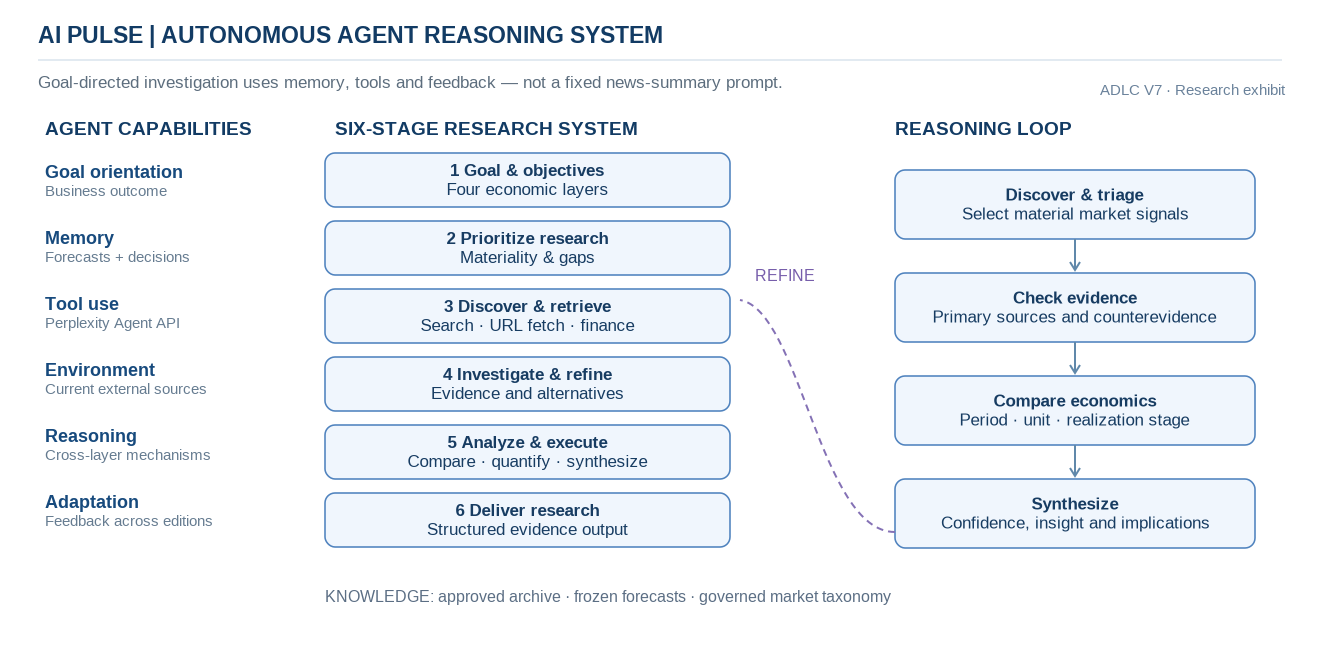
FIGURE 1 / AI Pulse agent logic: goal-driven investigation, tools, memory and an iterative reasoning loop.
The design brings agent capabilities into one operating logic: a defined goal, bounded autonomy, external tool use, historical memory, evidence-based reasoning and feedback-driven improvement. Evaluation findings guide changes to research instructions, tool strategy and system controls. The underlying model is not independently retrained by this process.
02 | Engineering intelligence through a business-linked scorecard
For an executive intelligence agent, quality must reflect the decision it supports. We created a six-dimensional, 100-point scorecard: economic and commercial insight (25), cross-layer causal reasoning (20), evidence quality (20), financial rigor (15), historical and forecast accountability (15), and editorial fidelity (5).
These weights translate the commercial objective into evaluation criteria. Source verification supports sound decisions; financial rigor separates recognized revenue, ARR and future commitments; causal analysis connects market developments to competitive advantage; and historical accountability tests previous assessments. By evaluating economic insight, financial evidence and cross-layer market relationships, the scorecard establishes measurable standards for intelligence supporting investment decisions, partnerships and commercial strategy.
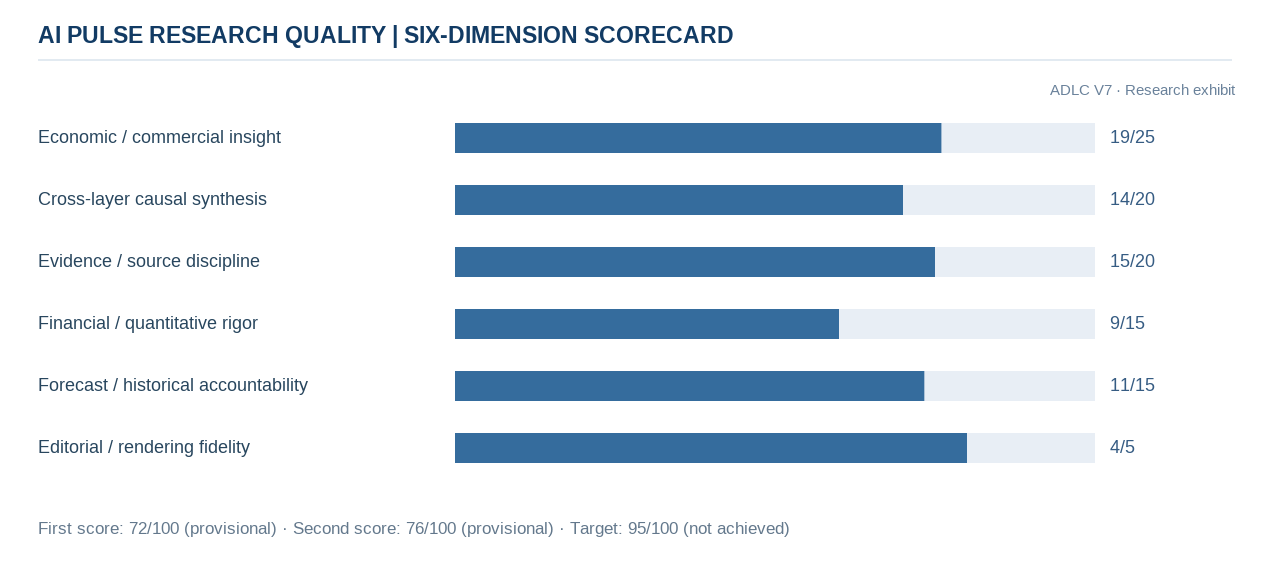
FIGURE 2 / Six-dimensional research quality: first provisional score 72/100; high-standard objective 95/100.
An edition requires at least 85/100 and must pass mandatory evidence, chronology, completeness and release checks. These gates protect decisions even when an aggregate score looks strong. The latest completed edition scored 76/100 provisionally; 95/100 remains the research-quality objective.
03 | ADLC controls that make autonomy dependable
Three bounded AI Pulse tests exposed issues in schema compatibility, depth of investigation and output-token limits. Those findings guided improvements to data contracts, evidence checks and execution controls. The experiments illustrate how ADLC feedback strengthens the overall design.
Execution contracts — Preserve raw model output, check field types and response completeness, normalize approved variations and retain replayable records. These controls support dependable integration with enterprise applications.
Evidence and financial assurance — Link material claims to documents, verify periods and units, distinguish revenue from ARR, backlog and capacity commitments, and preserve dated forecasts. These checks support financial and strategic decisions.
Evaluation and release — Use the scorecard and mandatory gates to determine readiness. Deterministic software renders the approved report, while the owner authorizes publication. Audit trails support review, recovery and accountability.
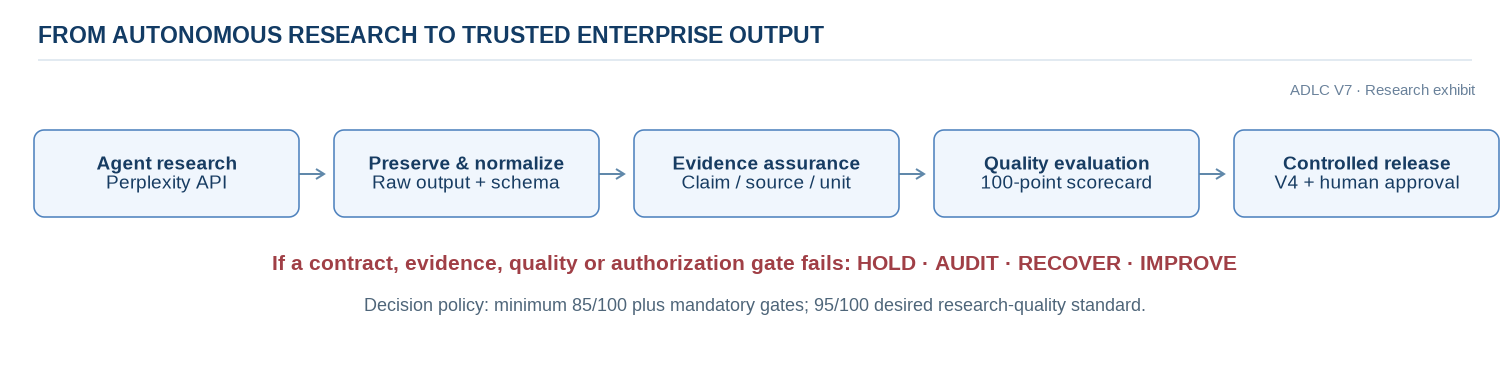
FIGURE 3 / Model-led investigation connects to software-enforced assurance, rendering and release control.
04 | A reusable pattern for Hi-Tech enterprise agents
The same design pattern can be adapted to Hi-Tech enterprise agents by changing the business goal, connected systems, trusted data, evaluation scorecard and approval boundaries. AI Pulse is the applied case study; the following are transferable enterprise applications and their measurable value drivers:
Market intelligence agents — Connect competitive moves, pricing and investment signals to strategic choices; track insight-to-decision time, market-entry decisions and revenue opportunities identified.
Product intelligence agents — Combine launch plans, roadmaps, product-performance evidence and customer feedback; track portfolio decisions, engineering rework avoided and time to market.
Customer support escalation agents — Investigate tickets using approved technical documentation and previous resolutions; track time to resolution, escalations avoided, cost per case and service gross margin.
Engineering knowledge agents — Retrieve design decisions, technical history and change records with traceable sources; track engineering hours redeployed, defect recurrence and release-cycle time.
Revenue and alliances intelligence agents — Analyze account signals, partner movements and competitive positioning; track qualified pipeline, win rates, account expansion and attributable gross profit.
05 | Commercializing agentic AI through P&L outcomes
Enterprise commercialization begins by linking each ADLC capability to an operational KPI and a financial result. The value mechanisms are concrete:
Governed memory → fewer repeated investigations and less engineering rework → lower delivery cost and additional specialist capacity.
Evidence assurance → more reliable product, financial and customer intelligence → fewer costly decision errors and stronger investment choices.
Autonomous investigation → broader market, account and partner coverage → more qualified revenue opportunities for sales and alliances teams.
Quality gates and recovery controls → less rechecking, remediation and failed execution → improved unit economics and service margins.
Commercial measurement should distinguish capacity released from realized cash savings, and qualified pipeline from recognized revenue. Organizations should validate adoption, attribution and the cost of verification, inference, tools, monitoring, recovery and human oversight. Each use case needs a baseline and a clear benefit owner.
Net annual value = Realized operating savings + Attributable incremental gross profit + Verified cost avoidance − Fully loaded agent operating costs
Illustrative Hi-Tech case: if an agent releases 1,000 verified specialist hours annually at a $90 fully loaded hourly rate, the gross capacity value is $90,000. Realized savings depend on how the business redeploys that capacity, avoids expenditure or converts it into additional contribution. This is a scenario, not a measured AI Pulse result.
For a Hi-Tech commercial leader, this measurement discipline supports prioritizing agent investments alongside sales programs, engineering initiatives and service transformation. Performance is demonstrated through verified outcomes, their reliability and their contribution to enterprise P&L.
Conclusion | ADLC connects engineering discipline with commercial leadership
The practical lesson from AI Pulse extends across enterprise agent engineering. An effective Agent Development Lifecycle joins three capabilities that reinforce one another:
Intelligence — Agents plan, use tools, reason with governed memory and investigate complex business questions.
Engineering assurance — Structured contracts, source checks, scorecards and recovery controls make outputs reliable and reviewable.
Commercial value — Enterprise leaders connect those outputs to faster decisions, revenue contribution, operating efficiency and margin improvement.
The enterprise opportunity is to integrate autonomous intelligence into commercial and operational workflows with measurable gains in decision quality, productivity, revenue contribution and operating margins. ADLC supplies the engineering discipline for reliable scale. AI Pulse offers a concrete applied demonstration of this broader design approach.
Research status, 15 November 2026: Three bounded paid tests; latest completed research assessment 76/100 (provisional); latest isolated candidate passed 185 software regression tests. Final live acceptance, full evidence audit and scheduled publishing remain pending.
Optional technical reference — Nine ADLC stages mapped to AI Pulse
Optional reference | Nine ADLC stages mapped to AI Pulse
Optional expandable technical reference: this nine-stage matrix maps an analytical ADLC framework to AI Pulse design choices and the transferable enterprise lesson. It does not assert a single universal ADLC standard.
ADLC stage | AI Pulse design / experience | Enterprise-scale lesson |
|---|---|---|
Problem and outcomes | Four-layer executive intelligence; quality rubric; fixed V4 output | Define measurable commercial value and acceptance criteria. |
Architecture and orchestration | Perplexity Agent API; bounded research request; downstream modules | Separate flexible model research from governed application processing. |
Tools and evidence | Web search; URL fetch; available finance capabilities; source ledger | Check appropriate tool use and source support for decisions. |
Context, memory and state | Archived editions; four frozen forecasts; 31-subcategory taxonomy | Preserve authoritative, dated enterprise knowledge. |
Contracts and execution | Structured research JSON; normalization; validator; renderer | Design recoverable interfaces with explicit data contracts. |
Evaluation and risk | 100-point rubric; evidence and chronology gates | Test business usefulness, factual support and failure conditions. |
Observability and recovery | Saved responses; usage and trace records; replay controls | Diagnose defects across model, tools and software. |
Release and operations | Unpublished review; locked V4 renderer; approval boundary | Separate generated intelligence, acceptance and release authority. |
Iteration | Findings inform research instructions, tools and checks | Improve the subsystem responsible for each quality gap. |
Optional visual references — Autonomous agent logic and reasoning loop
Optional visual references | Autonomous agent logic and reasoning loop
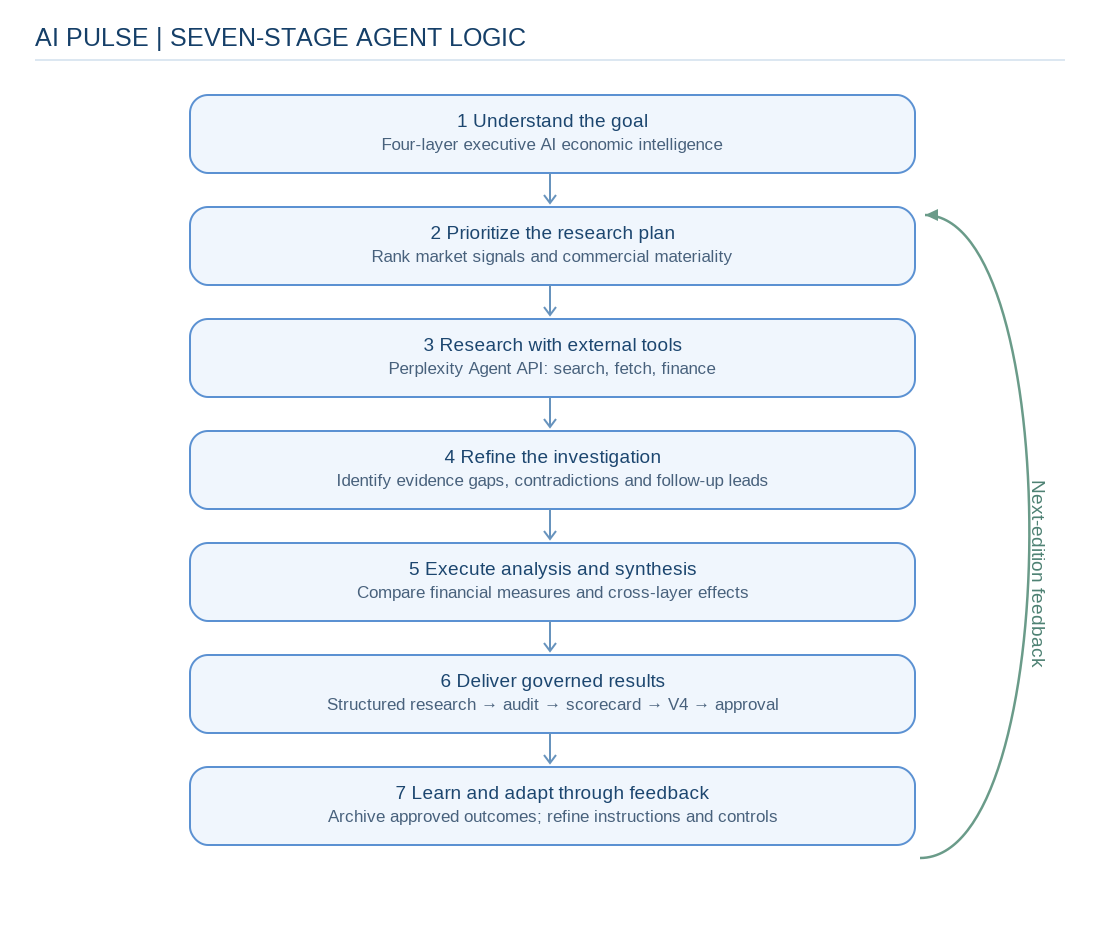
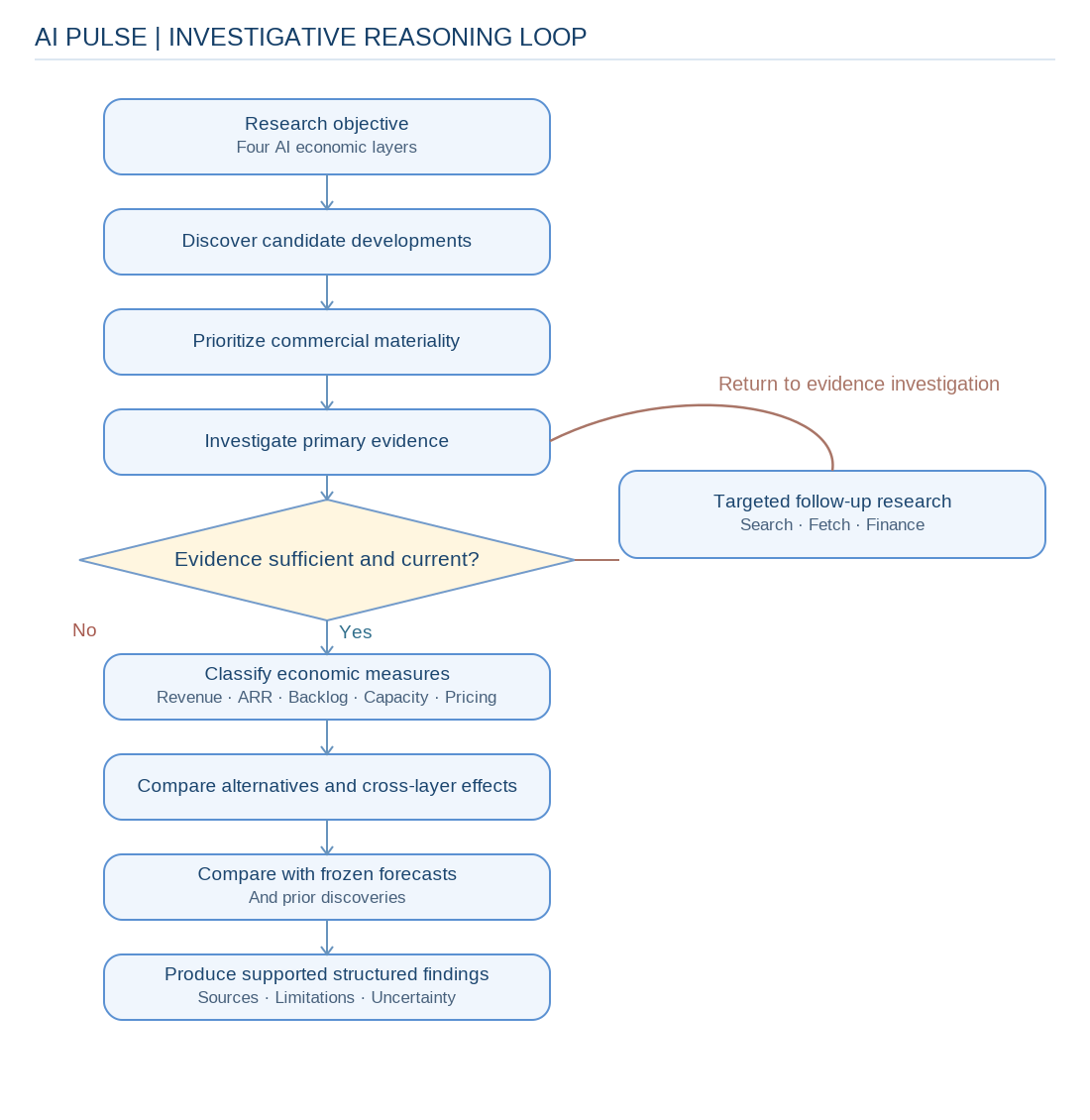
These two diagrams are supplemental technical references for a future expandable website section. They complement the three primary exhibits in the article. The original supplied overview contained illustrative commercial percentage claims without supporting enterprise measurements; the corrected diagram below omits those figures.
APPENDIX FIGURE A / Seven-stage autonomous agent workflow with iterative investigation and next-edition feedback.
APPENDIX FIGURE B / Targeted research follow-up, economic classification and comparison with governed memory.
Selected external research and frameworks
Anthropic, Building effective agents (2024) — https://www.anthropic.com/research/building-effective-agents
OpenAI, Evaluate agent workflows — https://developers.openai.com/api/docs/guides/agent-evals
OpenAI, Trace grading — https://developers.openai.com/api/docs/guides/trace-grading
NIST, AI RMF Generative AI Profile (2024) — https://www.nist.gov/publications/artificial-intelligence-risk-management-framework-generative-artificial-intelligence
These external frameworks provide engineering and governance context; they do not independently verify private AI Pulse experimental results.